```php ICAR-CRIJAF : Central Research Institute for Jute and Allied Fibres

भाकृअनुप - केन्द्रीय पटसन एवं समवर्गीय रेशा अनुसंधान संस्थान

ICAR - Central Research Institute for Jute and Allied Fibres

ISO 9001 : 2015 Certified Institute

CRIJAF Campus

All India Network Project on Jute and Allied Fibres

AINPJAF coordinates multi-location testing, technology validation and dissemination for jute and allied fibre crops across India.

8

SAU Based Centres

4

ICAR Institute Centres

121

High Yielding Varieties Released

About AINPJAF

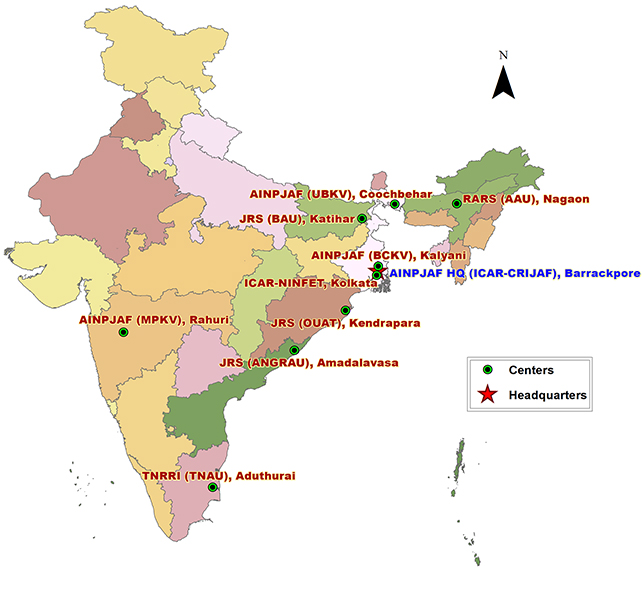
ICAR-CRIJAF has eight SAU based and four ICAR Institute based collaborating centres for multi-location testing and revalidation of technologies under All India Coordinated Research Projects on Jute and Allied Fibres, now functioning as the All India Network Project on Jute and Allied Fibres. ICAR-CRIJAF is the apex institute in the country for research on jute and allied fibres, focusing on the development of production technologies to enhance productivity in a sustainable manner.

Mandate

  • Development, multi-location evaluation and dissemination of technologies to enhance the productivity and profitability of jute and allied fibre crops on an ecologically and economically sustainable basis for increased indigenous availability of better-quality jute and allied fibres in the country.

Objectives

  • Generation and evaluation of new genetic material in multi-location trials to identify genotypes with broad and specific adaptation.
  • Development, evaluation and validation of crop management technologies for sustainable production and protection from biotic and abiotic stresses.
  • Trait discovery for improving jute and allied fibre crops using diverse germplasm resources.
  • Varietal maintenance and seed production.
  • Sharing of experience, knowledge and genetic material among stakeholders working in different parts of the country.

Location Map of AINPJAF

Location Map of AINPJAF

Salient Achievements

  • A total of 121 high yielding JAF varieties comprising tossa jute, white jute, kenaf, roselle, sunnhemp, ramie, flax and sisal have been released through AINPJAF since its inception.
  • Mesta-maize cropping sequence recorded maximum system fibre equivalent yield, net return and B:C ratio at Amadalavalasa, Andhra Pradesh and is recommended for deficit rainfall situations.
  • In neutral soil, targeted yield of jute was achieved through soil test based fertilizer application along with FYM in jute-rice cropping system at Katihar, Bihar.
  • The weed diversity of jute and mesta growing regions was studied and dominant weed species were identified in major growing areas of West Bengal, Bihar, Odisha, Assam, Andhra Pradesh and Tamil Nadu.
  • Survey and surveillance of insect pests of jute and mesta was conducted in all AINPJAF centres and adjoining areas. Yellow mite, semilooper, Bihar hairy caterpillar and stem weevil were found as common insect pests.
  • The Tribal Sub Plan programme was conducted in five districts of West Bengal, Odisha and Assam covering 300 ha area, benefiting around 1400 tribal farmers through improved production and retting technology demonstrations.
```